
Game Strategies and Tactics Nov 3, 2026, 1:28:26 PM Coach Wolfe 17 min read
In December 2021, Quincy beat Lincoln 33-30 in an Illinois holiday tournament quarterfinal. It looked like exactly the kind of game a shot clock is supposed to fix. Then David Adam, editor of the Quincy-based Muddy River Sports, went through the tournament's official stats. Of 81 possessions, 13 ran longer than 35 seconds. His conclusion: 84% of possessions would have been unaffected by a shot clock.
Illinois is one of several states turning the clock on for the first time this winter. If you coach in one of them, or your state just voted to follow, you've probably heard two predictions. One says the shot clock will turn high school basketball into a track meet. The other says it will wreck the patient, disciplined game you've spent years teaching.
The evidence so far supports neither. The 35-second clock rarely touches most possessions. It does change the game at the end of quarters, at the end of tight games, and in the short-clock moments after a deflection or a timeout. Those are the moments that decide close games.
This piece covers where the rule stands, what changes and what doesn't, and how to get your team and your staff ready. Take what fits your program.
Where things stand this season
The National Federation of State High School Associations (NFHS) approved the 35-second shot clock in 2021, with states allowed to adopt it starting in 2022-23. It's a state-by-state option, not a national mandate. Before that vote, nine states already used a 30- or 35-second clock, including California, New York, Georgia and Washington (CBS Sports).
How many states use it now depends on who's counting. The NFHS said 32 states were using a shot clock "in some form or fashion" going into 2025-26 (NFHS). MaxPreps counted 24 state associations for that season, with six more mandates starting in 2026-27. The gap comes from states that use it only in some games, some classifications, or by mutual agreement.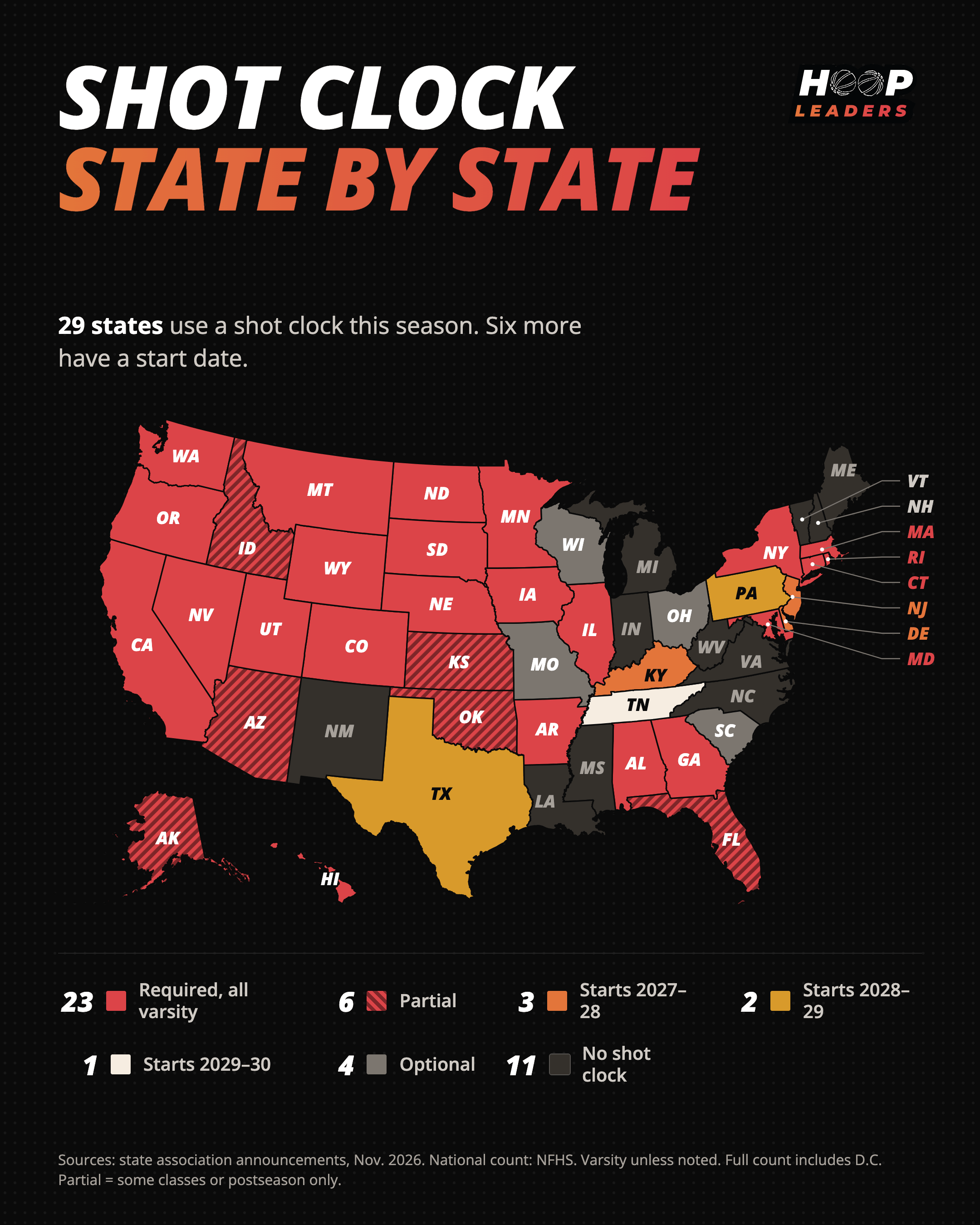
Here's where some of the recent movers stand:
| State | Status | When |
|---|---|---|
| Illinois | Required for varsity (Shaw Local) | 2026-27 |
| Alabama | Required, all classifications (WAFF) | 2026-27 |
| Colorado | Required for varsity, all classifications (Sentinel Colorado) | 2026-27 |
| Oklahoma | Required in 6A-3A; optional for smaller classes by agreement (News On 6) | 2026-27 |
| Wyoming | Required, all classes (Powell Tribune) | 2026-27 |
| Kansas | Required in the postseason, phased in by class (KVOE) | 6A-4A 2025-26, 3A-2A 2026-27, 1A 2027-28 |
| Florida | Required only for state semifinals and finals (WMBB) | 2026-27 |
| Kentucky | Optional in non-district games this season, required for varsity next (LINK nky) | 2027-28 |
| New Jersey | Approved 170-166 (Athletic Business) | 2027-28 |
| Delaware | Required for varsity (DIAA) | 2027-28 |
| Pennsylvania | Required for varsity and JV (Central Bucks News) | 2028-29 |
| Tennessee | Holiday tournaments and showcase events first (Main Street Media) | Full use 2029-30 |
| Texas | Approved Oct. 19, phased by classification (Tyler Morning Telegraph) | 6A-5A 2028-29; 4A-3A no earlier than 2030-31 |
This spring, Indiana voted the clock down 17-1 and North Carolina rejected it 17-0 (MaxPreps). Ohio hasn't voted, but it approved 11 shot clock events for this season (Dayton Daily News).
Most states start with varsity. Pennsylvania also includes JV but leaves junior high out (Butler Eagle), and Texas isn't recommending a clock for middle school.
Try this: Download your own state association's shot clock guidelines for 2026-27. Don't rely on the NFHS book alone. As the next section shows, some of the details that matter most vary from state to state.
The rules you need to know
The NFHS Shot Clock Guidelines are the starting point. They're recommendations, and states can change pieces of them, such as using a partial reset after a kicked ball (NFHS). Here's the short version of the NFHS baseline.
When the clock starts: When the ball is touched inbounds on a throw-in, or when a team gains control after a jump ball or a missed shot. It doesn't start on a made basket. That's the source of a common first-year operator error (more on that below).
Full reset to 35: On a change of possession, after a score, after a foul or violation, and when a shot hits the rim and either team rebounds it.
No reset (you keep what's left): When the defense deflects the ball out of bounds, when a timeout ends, after an injury, or when the possession arrow gives the offense a held ball. These are your short-clock situations, and you need plays for them.
When the clock turns off: When a reset situation happens and the game clock shows less than a full shot clock. Below that point, the end of a quarter plays like the game you already know.
The horn doesn't stop play. Only an official's whistle does. To beat the horn, the shot has to leave the shooter's hands before it sounds, then hit the rim or go in.
Errors are only fixable in the moment. An operator mistake can be corrected during the same shot clock period in which it happened, and only when the official has definite information about it. Once the next shot clock period starts, the mistake stands.
Now the state differences. A few examples:
- Minnesota resets to 20 seconds, not 35, after an offensive rebound in the frontcourt. After a defensive foul or kicked ball with a frontcourt throw-in, it resets to 20 or the time remaining, whichever is greater (MSHSL modifications).
- Georgia resets to 25 seconds on an offensive rebound (GHSA shot clock protocol).
- California uses 35 seconds for boys and 30 for girls in the Southern Section (CIF-SS).
A coach who expects a full 35 after an offensive rebound, in a state that gives 20 or 25, will burn seconds pulling the ball out to reset.
There's also a new game-clock rule this season. In the last 59.9 seconds of a quarter, at least 0.3 seconds must run off the game clock before a player can legally touch a throw-in or a missed free throw inbounds, if the clock shows tenths (TASO). That affects the end-of-quarter catch-and-shoot plays you'll be running with the shot clock off.
Try this: Make a one-page reset sheet for your state with three columns: full reset, partial reset, no reset. Tape it to your clipboard for the first month.
What Changes (and Doesn't change) with the clock
Start with the arithmetic. A 32-minute game is 1,920 seconds. Divide that by 35 and the clock guarantees roughly 55 possessions, total, for both teams. In other words, the clock only forces the issue for a team averaging more than 35 seconds a possession, which is a very slow pace even for a patient team.
What data exists backs that up:
- The Quincy-Lincoln game above had 84% of possessions finish under 35 seconds (Muddy River Sports).
- When Pennsylvania debated the clock, its packet cited a New Mexico study that found the clock expired in about 5% of possessions over two years (TribLive).
- Hewitt-Trussville (Ala.) coach Jeremy Monceaux said his team had one shot clock violation in 13 games played with an optional clock last season, while his defense forced three (ABC 33/40).
- A 2014 MaxPreps analysis of about 137,000 boys' scores, from a season when only seven states used a clock, found slightly higher combined scoring in states without one (104.2 to 101.4 points). That compares states with each other, not before and after, so it can't show the clock lowers scoring. It does make it hard to argue the clock raises it.
- In Georgia, Norcross coach Jesse McMillan told Sports Illustrated that a team might play 28 or 29 minutes without the clock mattering. In his experience it came into play mostly in close games and on the short clock after a loose ball or a foul.
No state has published before-and-after numbers on pace or efficiency, so treat all of this as early evidence. For most teams, the clock mostly matters late in games and on short-clock possessions. If you spend the preseason trying to turn your team into a run-and-gun group, you may be preparing for the wrong thing.
The end of the game is where it bites
This is where the game changes most, and where your preparation time will pay off.
Stalling is gone. You can't spread the floor and sit on a four-point lead for the last three minutes anymore. If you've relied on that for years, it's the biggest habit to replace.
The trailing team gets a real choice. Without a clock, a team down four with 1:30 left almost has to foul. With one, Hatton (Ala.) coach Justin Henley told the Decatur Daily, "you can decide whether you want to foul or defend." When there's more time on the game clock than the shot clock, a defensive stop guarantees you get the ball back. Fouling makes more sense once the game clock drops under the shot clock, which is also when the shot clock turns off.
The 2-for-1 becomes a real tool. With about 40 to 45 seconds left in a quarter, a good shot early in the possession can earn you one more trip at the end. Without a clock, the other team could just hold for the last shot. With one, they have to shoot.
Protecting a lead takes a plan. A California coach who writes as Coach Battenberg has coached with and without a clock. His "2 Minute Offense" takes any wide-open layup. Otherwise it runs the shot clock down to 10, then uses a set play to get a shot off under 5 seconds, such as a pick-and-roll with the best guard and the best big. He says playing with a shot clock "requires more coaching."
Try this: Write a one-page end-of-game sheet before your first game. It should answer three questions: When do we foul vs. defend when trailing? When do we go 2-for-1? What's our lead-protection offense, and what's the play at 10?
Offense: get in earlier, and have answers for the last 10 seconds
Most teams can keep their offense. The work is in starting it sooner and finishing it better.
Get into your offense earlier. If your team walks the ball up and runs a long, patient sequence, you lose the cushion to reset when the first action fails. Push the ball past half court and flow into something right away.
Build a late-clock menu. Two to four simple options are enough:
- A high ball screen for your best creator.
- A handoff into a downhill drive.
- A clear-out for your best one-on-one player.
- A quick hitter that ends in a catch-and-shoot.
Have short-clock inbounds plays. Remember the no-reset list: a defensive deflection out of bounds, a timeout or an injury leaves you whatever was on the clock. Maple Grove (Minn.) coach Mark Cook told the Star Tribune that teams need a menu of inbounds plays for a low shot clock, because there's no time to inbound and then run three screens. You want sideline and baseline plays that get a shot off in 3 to 8 seconds.
Teach shot selection by clock phase. A 2011 paper by physicist Brian Skinner, comparing a shot-selection model with NBA data, suggested players tend to wait too long before shooting (arXiv). That's a model built on pro data, so don't lean on it too hard. The coaching message still works at any level: a great shot early is fine, and a good shot late is required.
Keep the ball moving late. A lot of late-clock trouble starts with one guard dribbling the air out of the ball. Teach players to move it while there's still time for a second decision.
Try this: Give your late-clock plays one-word calls your players can hear over a crowd. Run each one from 10, 7 and 4 seconds until the timing is automatic.
Defense: the clock is now on your side
For a lot of teams, the shot clock helps the defense more than the offense. You only have to guard for 35 seconds.
Use pressure to take time off the clock. A soft three-quarter or full-court press that costs the offense 6 to 8 seconds leaves them under 30 to run their half-court offense. Under the NFHS guidelines, officials also use the shot clock to count the 10-second backcourt limit.
Mix in a zone, or change defenses mid-possession. Chestatee (Ga.) girls coach Sutton Shirley, whose team plays man about 99% of the time, went to more zone in one game and said they did "a pretty good job of defending 25 or 30 seconds" (Sports Illustrated). Changing looks partway through a possession is a reasonable bet against teams that are new to the clock.
Have late-clock rules. When the shot clock is under 10, contest without fouling. A foul gives the offense a fresh clock, and their late-clock shot was likely to be a tough one.
Try this: In practice, score your defense on whether the offense gets a shot off before the clock hits 10, not only on whether they score.
If you've always played slow
Teams that already play fast usually adjust without much trouble, since their possessions rarely get near 35 seconds. Their bigger risk is on defense, like a player relaxing when the opponent's horn sounds even though no whistle has blown.
Patient, deliberate teams have the bigger adjustment. Gilmer (Ga.) coach Dani Wright told Sports Illustrated that her team plays a little slower while it learns the transition game, and it had picked up a few more violations than she'd seen at her previous schools.
If that's you, you can keep your style. Time one full cycle of your offense. If it takes more than about 20 to 25 seconds, shorten it or add a quicker trigger action at the start, so there's still time for a late-clock option when the first cycle doesn't produce a good look.
There's also a real competitive-balance debate. Marty Johnson, executive director of the Indiana Basketball Coaches Association, opposes the clock even though he says about 65% of his coaches support it. His question: "I don't understand why a coach would willingly give up a coaching option that could help their kids be successful" (USA TODAY via AOL). Support drops at smaller schools too. In Oklahoma's survey, 94% of 6A coaches favored a clock, compared with 45% of Class B coaches (McIntosh County Democrat). That's part of why Oklahoma and Texas phased it in by classification.
On the other side, 35 seconds still allows a lot of patience. An underdog can use 25 or 30 seconds a possession and keep the game short. The extreme version is what's gone: holding the ball for minutes at a time late in the game.
First-year mistakes to watch for
A handful of problems come up again and again in the first season.
Rushing early. Expect some players to hurry shots in the first few games just because they know the clock is there. Coach patience within the 35 seconds.
Panic late. The opposite problem: a forced 30-footer at the horn. Rehearsed late-clock plays are the fix.
Stopping on the horn. The horn alone doesn't stop play. Players keep going until they hear a whistle.
Not knowing your resets. See Section 2. This one shows up in timeouts, when a coach calls a play built for 35 seconds and the team has 12.
Operator errors. Benet Academy (Ill.) girls coach Joe Kilbride said operators in shot clock games occasionally started the clock after a made basket instead of on the inbound, which led to premature violations (NCTV17). Errors can only be fixed within the same shot clock period, so raise it right away. Get an official's attention at the next dead ball and work through the official, not the table.
Untrained table crews. Table mistakes decide games. In a Georgia girls' state tournament game this past March, the game clock never started with 6.8 seconds left, and the winning basket stood (BroBible). That was the game clock, but a second clock is a second chance for the same kind of error. Ask your AD who will run it and how they'll be trained.
JV call-ups. In states where sub-varsity plays without a clock, players called up have to adjust. Wright mentioned this at Gilmer (Sports Illustrated). If your JV doesn't play with a clock, it can still practice with one.
Try this: Before your first home game, meet your shot clock operator. Walk through when the clock starts, the no-reset situations, and what happens if the clock malfunctions. A 10 minute walkthrough now could potentially save an error that costs a game this season.
Getting your staff and your practices ready
Your staff:
- Learn your state's rules, not just the NFHS version. Highlight resets, when the clock turns off, error correction, and which levels it covers.
- Assign a shot clock coach. One assistant watches nothing but the shot clock and calls out reset situations. Maple Grove's staff trained JV players on the varsity bench to start counting out loud at 10 (Star Tribune).
- Agree on a call. A verbal cue like "Ten!" then "Five!" and a hand signal players can see from the floor.
- Check both clocks in every timeout. Every after-timeout play needs a full-clock version and a short-clock version.
Your practices:
- Run a clock in every live segment from day one. A portable clock or a phone app works if your practice gym doesn't have one. The goal is for players to stop noticing it.
- Late-clock drill. Start possessions with 12, 8 and 5 seconds. The rep only counts if it ends in a good shot.
- Short-clock inbounds. Blow the whistle for a "deflection out of bounds," call out a random time like 6 seconds, and make them score.
- Reset recognition. A manager calls out situations (kicked ball, offensive rebound, defensive foul) and players shout back the correct clock for your state.
- End-of-quarter work. Game clock under 35, shot clock off. Practice holding for the last shot, and the 2-for-1 at about 40 seconds.
- Clock-burn defense. Press into half-court defense, scored by whether the offense gets a shot before 10.
There's no published standard for how many late-clock reps to run. I suggest 10 to 15 late-clock possessions per practice in the preseason, then 5 to 10 once the season starts. Adjust to your team.
Scouting: Add a late-clock line to your scouting report. Who gets the ball under 10 seconds? Do they have a set? How do they handle short-clock inbounds?
If you run a feeder program
Middle school mostly won't have a clock, even in states that require one in high school. Texas, for example, isn't recommending one for middle school because it wants the focus on developmental play and time management (Tyler Morning Telegraph).
Some of your players may already have played with a clock in club or AAU events. That helps, but don't assume all of them have.
Feeder coaches don't need to play every game with a clock. A reasonable middle ground for 7th and 8th grade is clock awareness: a scrimmage clock in practice, an occasional late-clock decision drill, and teaching kids to look up. At that age, spacing, ball movement and finishing matter far more than tempo.
Your shot clock checklist
- Get your state's 2026-27 shot clock guidelines and make a one-page reset sheet.
- Confirm with your AD who runs the shot clock at every level, how they're trained, and the backup plan if it fails.
- Assign one assistant to the shot clock and one bench player or manager to call out 10 and 5.
- Write your end-of-game sheet: foul vs. defend, 2-for-1, lead-protection offense.
- Install two to four late-clock plays, plus short-clock sideline and baseline plays.
- Time one full cycle of your offense. If it's over 20 to 25 seconds, shorten it.
- Run a shot clock in every live practice segment from day one.
- Script timeout scenarios where you read both clocks out loud before calling the play.
- Add late-clock tendencies to your scouting report.
- Meet your operator before your first home game.
Is your state switching this year, or are you a few seasons out? Head over to the Hoop Leaders community and tell us what you're most worried about. For more on running games with a clock, Underdog Hoops has a solid breakdown.

Coach Wolfe
Hi! I'm Mike Wolfe. I’ve coached high school basketball for 15 years, and if there’s one thing I know for sure, it’s that growth never stops for players or coaches. I created Hoop Leaders to share what I’ve learned, admit what I’m still figuring out, and collaborate with coaches who believe the job is bigger than wins and losses. Here, we trade ideas, sharpen fundamentals, build confidence, and strive to keep our athletes mentally, physically and spiritually healthy—so they leave our programs better players and even better people. I hope you'll join us!
Let's Coach Better, Together.